I learned today that each Google Gemini query consumes roughly five drops of water, yet that is only part of the truth.
Nov 24, 2026
Google's Five Drops per Gemini Prompt Hide the Larger Water Cost of AI
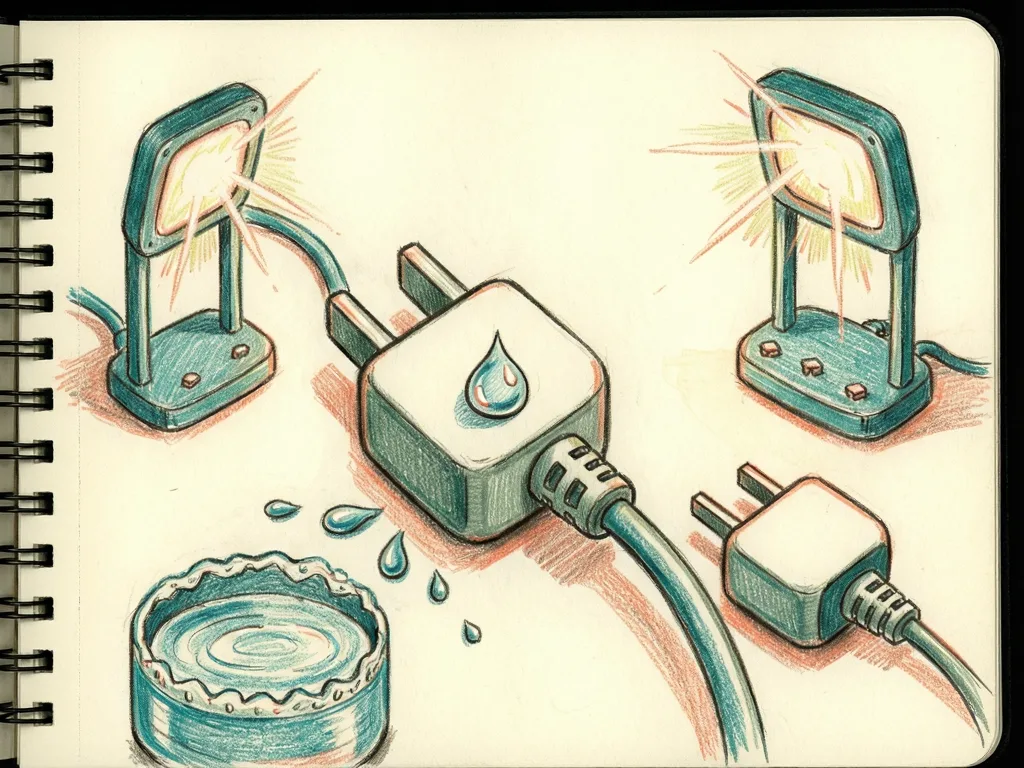
The public framing is that asking Gemini to rewrite an email costs about five drops of water. In an August 2025 technical paper, Google estimated that a median Gemini Apps text prompt uses 0.24 watt-hours of energy, emits 0.03 grams of carbon dioxide equivalent and consumes 0.26 milliliters of water. Google compared the energy use to watching TV for less than nine seconds. It also said that over a 12-month period, the energy and carbon footprint of a median prompt fell by 33 times and 44 times respectively. Those are large efficiency claims, if the calculations hold.
But the five-drop figure is a narrow accounting result. It is most useful as a per-request efficiency metric, not as a full answer to what AI services consume at scale.
The method includes more than the accelerator alone
Google's method counts more than the chips doing the model work. Alongside the AI chips themselves, it includes host CPUs and memory, idle machines kept on standby, and data center overhead such as cooling. By Google's own breakdown, the AI accelerators account for 58% of the energy behind each prompt. Host CPUs and memory take another 24%, while spare capacity and data center overhead make up the remaining 18%.
If only active tensor processing units and GPUs were counted, the figures would fall to 0.10 watt-hours and 0.12 milliliters. Google itself calls that an underestimate. That distinction matters: a prompt does not run on an accelerator in isolation, and the standby machines that keep the service responsive also consume resources.
The water number rests on a limited boundary
The most important limitation is in the water figure. Google's estimate covers only the water consumed on-site to cool its data centers, calculated from its 2024 fleet-wide average. The fine print also notes that the data has not been verified by an independent third party.
Power plants also consume water, for cooling and for producing steam that spins turbines. Shaolei Ren, a UC Riverside associate professor whose research the paper cited, said of the omission: "They're just hiding the critical information." Ren made that remark to an interviewer.
Google said its five-drop figure was far below a previous estimate of about 50 milliliters per prompt drawn from Ren's work. Ren responded that his figure already included off-site water. His 2023 study estimated that GPT-3 consumed a 500-milliliter bottle of water for every 10 to 50 medium-length responses, depending on when and where it ran.
The excluded share is not a rounding error
That excluded share is not a small correction. A 2024 Lawrence Berkeley National Laboratory report found that the water used to generate electricity for US data centers in 2023 was about 12 times the amount they used for cooling. Meta, the only hyperscaler that discloses this figure, puts its own indirect water use at more than 20 times its direct use.
The comparison with Google's on-site cooling water therefore turns on a boundary choice. Including only direct data center water can make a single prompt look small. Including the water used upstream to generate electricity makes the footprint much larger.
A median prompt and an average service are not the same
Ren and Alex de Vries-Gao, founder of Digiconomist, also took issue with Google comparing its median prompt against their averages. A median is the middle value in a set of prompts, while an average can reflect a broader mix of usage patterns. The disagreement is not only arithmetic; it is about which question the number is answering.
Both researchers argued that Google should have reported location-based emissions, which reflect the actual power grid near each data center, rather than market-based figures that credit its clean energy purchases. That distinction matters because a market-based figure can credit clean energy purchases even when the grid near a data center is not low-carbon.
Scale changes the interpretation
The per-prompt figure becomes more consequential when multiplied across a large user base. The Gemini app passed 1 billion monthly active users in August 2026. Meanwhile, Google's latest environmental report shows its total water consumption rose 34% to 10.9 billion gallons in 2025.
Those facts can coexist: a median prompt can become more efficient while total water use rises. The efficiency trend may show progress in the way individual requests are handled. The total consumption trend shows the pressure that scale places on data center operations.
The risk for readers is that a precise, small number can feel reassuring without showing the full system boundary. Five drops per prompt may be technically accurate under Google's chosen method. It does not by itself capture off-site water used for power generation, location-specific grid conditions, third-party verification, or the cumulative impact of billions of prompts.