Review: Am I Nima shows how a young girl’s mind becomes a creepy puzzle.
Nov 27, 2026
Am I Nima is most compelling when it treats language as the player’s only way to reconstruct a self that has been stripped away. The psychological horror game from developer HO! Games and publisher Outersloth asks the player, in the role of a young girl, to survive a basement, answer a mother’s tests, and make sense of a messy reality without memories. On PC, the reviewed version, its core judgment is clear: the game’s fear comes less from direct threat than from the pressure to perform identity through words. That design gives it a distinctive analytical shape, while also creating the main risk—word combinations may feel arbitrary when the player cannot see why a pairing works.
A Basement Built on Missing Memory
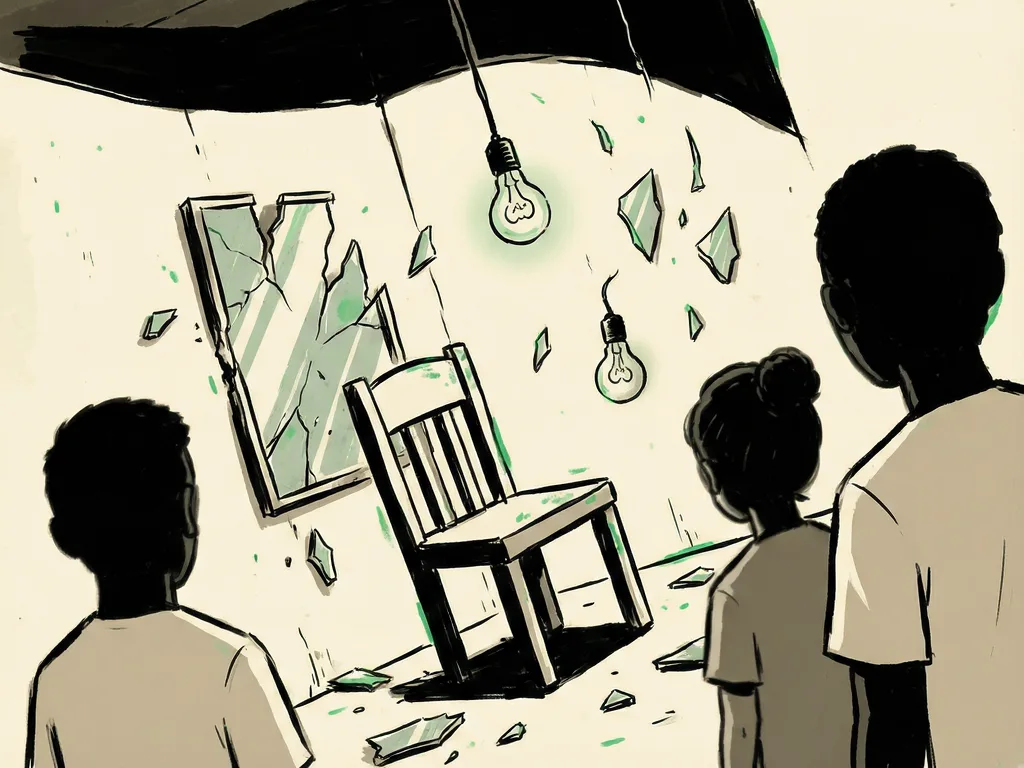
The opening frames the horror as disorientation rather than spectacle. The player wakes up in a dark basement while someone calls out. The stranger seems surprised that the player is breathing again, and it takes time to understand what is happening, who the character is supposed to be, and who this person with her is. Am I Nima then becomes a horror adventure through a messed-up situation of family abuse and psychological manipulation. Because the protagonist has no memories, the player must dig for some semblance of self, learning more with time.
This premise also explains why the game does not rely on jump scares alone. The creepiness is layered: it is hard to know what to trust, and the confined space of the basement makes paranoia easy. The horror is not only that the character is trapped; it is that the player has to define her from the outside, through fragments, while the person controlling the situation is already there.
Point-and-Click Exploration Turns Objects Into Words
The gameplay is a text-driven adventure with point-and-click elements. Players interact with the basement by clicking on various objects in Nima’s room to think about them. The review highlights three concrete examples: a worn-out plushie, a locked drawer, and an old note scribbled in hurried handwriting. These objects are not just scenery; they generate words that represent Nima’s thoughts and emotions, giving a peek into how she thinks and feels.
Words appear in Nima’s brain after dialogues, internal monologues, and interactions with the world. The player can connect them with one another to create new associations. Some connections open new words, while others circle back to terms already found. To find the truth, the player must actively combine words in Nima’s mind, experimenting with different pairings to unlock deeper meanings and access buried memories.
The player is invited to ask why combining certain words results in specific terms. That question matters because the associations are not only mechanical puzzles; they reveal the situation, Nima’s self, and the layers of interpretation behind simple words like mom, dad, or family.
The interface reinforces this as a mental workspace. On the left side of the screen, there is a list with all words acquired so far, allowing the player to search for them and reuse them in different contexts. On the right side, a brain serves as the current storage of recent information, with Nima’s face below; when the player drops words for usage, that face becomes like a shadow. The center of the screen shows what the character sees, while the borders keep the vocabulary system constantly visible.
Tests With the Mother Make Vocabulary Socially Dangerous
The mother’s tests are the clearest proof that Am I Nima is not merely a word puzzle. Words become dialogue choices at specific points, and specific terms lead to different replies when the player talks to Nima’s mother as part of her evaluations. Some replies move the experience forward in different manners, while others may be jokes or not be considered enough for her evaluations. The player is repeatedly asked to choose words carefully, because they change how Nima responds to her mother.
This mechanic gives the horror a social edge. The questions raised by the story are not just about escape: Why has the mother locked Nima in the basement? What do these tests mean? Are you really Nima? The game’s tagline—You don’t remember who you are. Act like her. Talk like her.—fits this system because performance is survival. The player may try to tell the mother what she wants to hear, or probe her for the truth, but each choice reveals something about Nima’s understanding of the world.
Red Light, Normal Faces, and a Distorted Mind
The game’s atmosphere depends on graphic elements and sound working together. The reviewer’s account suggests the experience crawls under the player’s skin. The environments are generally dark and claustrophobic, and it can be hard to see things and define them. The test room is especially important: when the mother shows up to open the room, the angle of her face is messed up, and her expression looks scary, like a judgmental stare. The red light in that room doubles down on the feeling of danger.
Am I Nima also uses visuals to suggest mental distortion. Some special memories appear blurred, distorted, and dark, making them feel like abstractions of a distorted mind. Specific animations and set pieces come up to give certain moments their own spotlight, changing the visuals significantly. At the same time, Nima and her mother look extremely normal, like characters from a cartoon show. That normality becomes part of the discomfort: when the player stops to analyze the context, the ordinary appearance makes the situation more disturbing.
The sound design works through restraint. The game tends to seem silent, using simpler tunes and an underlying noise that gives the experience an eerie tone. Voices show up only at specific times, and the reviewer notes that this took them off guard a few times, making spoken words feel more unsettling when they finally arrive.
Strengths, Friction, and Unresolved Risk
The game’s strongest achievement is the way its keyword system rewards exploration. Combining words can keep a player looking into every possibility for hours if they are inclined, instead of only pushing the gameplay forward. That can be fascinating, especially when the associations reveal layers behind simple terms like mom, dad, or family. Its thought-provoking story, unique word-based system, heavy themes that deeply resonate within the experience, and great use of visuals and sounds for immersion are the main points in favor.
The risk is that the system can feel arbitrary at times. There are limits to the combinations programmed in the game, so finding the right pairing may become a puzzle that depends on guesswork rather than clear logic. Figuring out what works and what does not is part of the fun, but the same feature can frustrate players who want more direct guidance. The experience may also be difficult to separate from its heavy subject matter: family abuse, trauma, and paranoia are not just atmosphere; they shape the way every word and reply is interpreted.
For readers, the practical takeaway is simple. Am I Nima is best understood as a psychological horror game for players who enjoy dissecting clues, testing language, and tolerating ambiguity. Its unique word-based system offers hints about the protagonist’s understanding of the world, but it does not promise a smooth path through the basement. The end result is a bold horror adventure that can be fascinating for genre fans who want to examine the mechanics of fear, memory, and manipulation rather than wait for the next scare.
Version Reviewed: PC.